
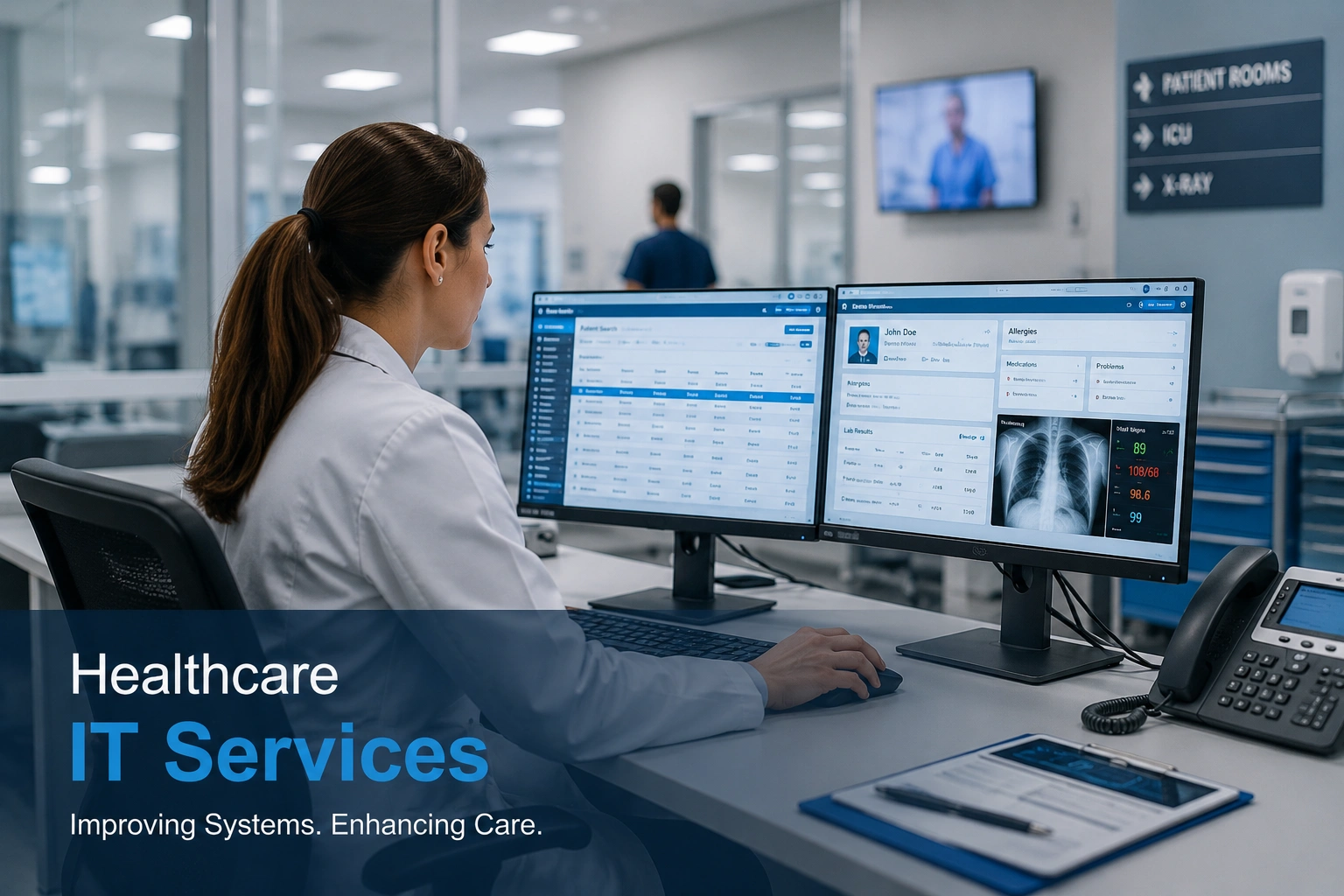
Healthcare IT Services

Your EHR Is Patient Safety Infrastructure. Treat It Like One.

North Carolina’s healthcare sector is growing faster than the Triangle’s IT infrastructure has adapted to support it. Independent practices expanding into multi-location operations, behavioral health organizations scaling their clinical capacity, specialty clinics opening satellite offices, and dental groups consolidating under single ownership structures are all creating IT complexity that general-purpose managed service providers are not equipped to manage within the regulatory framework that healthcare requires. At the same time, ransomware attacks on healthcare providers have reached record frequency, OCR enforcement activity against small and mid-sized covered entities has increased, and the average cost of a healthcare data breach has reached nearly ten million dollars.

CSP Inc. provides managed IT services for independent medical practices, dental offices, behavioral health organizations, physical therapy and rehabilitation clinics, and specialty providers across Raleigh and North Carolina. We sign a Business Associate Agreement before we access any system or data containing protected health information. We implement the technical safeguards the HIPAA Security Rule requires by regulatory citation, not by interpretation. And we support the EHR platforms your clinical operations depend on with response standards that match the urgency healthcare requires.

  • $9.8M Average U.S. healthcare breach cost in 2024 (IBM)
  • 60%+ Healthcare ransomware victims have under 100 staff
  • 100% CSP healthcare engagements begin with signed BAA
  • 25+ Years serving NC businesses from Raleigh

The Clinical and Compliance IT Failures That Put North Carolina Practices at Risk

  • No Business Associate Agreement With the IT Provider
    Under 45 CFR 164.308(b)(1), covered entities must enter into Business Associate Agreements with vendors who access, create, receive, transmit, or maintain protected health information on their behalf. An IT provider who accesses your network without a signed BAA is not just an oversight. It is a HIPAA violation that the covered entity, not the IT provider, bears the regulatory consequences for. CSP Inc. executes a Business Associate Agreement before we access any system containing ePHI. Without exception. Every healthcare engagement we have begins with this document.
  • HIPAA Risk Assessment Has Never Been Formally Conducted
    Under 45 CFR 164.308(a)(1)(ii)(A), covered entities must conduct a risk assessment that accurately identifies potential risks to the confidentiality, integrity, and availability of ePHI. OCR requests this document in virtually every breach investigation and in many routine compliance reviews. Most independent practices in North Carolina have never conducted a formal risk assessment. The absence of this document is itself a HIPAA violation, and it is one of the most commonly cited deficiencies in enforcement actions against small covered entities.
  • EHR User Access Has Never Been Reviewed Since Initial Implementation
    Staff who left the practice eighteen months ago may have active credentials in the EHR. Former employees with access to patient records represent one of the most common origins of insider-related HIPAA breaches. Under 45 CFR 164.312(a)(2)(i), covered entities must implement technical procedures to control access to ePHI, which includes removing access promptly when authorization ends. CSP Inc. conducts access reviews for healthcare clients and manages same-day access termination when staff leave, with documentation of every change.
  • Clinical Workstations Do Not Have Automatic Logoff Configured
    Under 45 CFR 164.312(a)(2)(iii), covered entities must implement electronic procedures that terminate an electronic session after a defined period of inactivity. In most clinical environments, workstations in exam rooms and nursing stations remain logged into the EHR indefinitely. A patient who accesses an unattended workstation, a vendor in the facility, or an unauthorized person in a clinical area can access patient records through a session that should have terminated. CSP Inc. configures automatic logoff across all clinical workstations as a baseline requirement for every healthcare engagement.
  • Connected Clinical Devices Are on the Same Network as Patient Record Systems
    Imaging systems, infusion pumps, patient monitors, ECG machines, and other networked clinical devices typically run operating systems that cannot receive security patches, have known vulnerabilities that are publicly documented, and in most practices are connected to the same network segment as clinical workstations and administrative computers. A compromised medical device provides network access to your EHR server and to the administrative systems storing billing data and patient demographics. Without network segmentation that isolates clinical devices, a breach of any single device is potentially a breach of your entire clinical environment.
  • Backup Recovery Has Never Been Tested Against an Actual Restore Scenario
    Most practices have some form of backup in place. Very few have tested whether that backup actually restores the EHR database, the billing platform, and the patient scheduling system under realistic recovery conditions. Under 45 CFR 164.308(a)(7)(ii)(B), covered entities must implement disaster recovery procedures. A backup that has never been tested is not a recovery asset. It is an assumption. CSP Inc. tests recovery procedures on a documented schedule and produces the test results your HIPAA compliance file requires.
  • Telehealth Was Deployed Without a HIPAA Security Review
    Telehealth platforms deployed quickly to meet patient care needs during the 2020 public health emergency were often stood up without a formal assessment of whether the platform met HIPAA technical safeguard requirements or whether the provider device and network environment used for virtual visits met the standards required for ePHI transmission. Many North Carolina practices are still operating telehealth infrastructure that has never been reviewed against HIPAA requirements. CSP Inc. assesses and corrects telehealth environments as part of our standard healthcare onboarding.

Does Your Practice Have a Signed BAA With Your Current IT Provider?

If not, you are already in a HIPAA violation. CSP Inc. executes a BAA before we access anything. Every healthcare engagement starts here.

Why Healthcare IT Demands Regulatory and Clinical Expertise Beyond Standard IT Support

  • HIPAA Is a Regulatory Framework With Enforceable Technical Requirements, Not a Guideline
    OCR has levied civil money penalties against covered entities, including solo physician practices, small dental offices, and independent specialty clinics for specific, measurable failures in technical safeguard implementation: failure to conduct risk assessments, failure to implement access controls, failure to encrypt ePHI, failure to maintain audit logs. These are not penalties reserved for large health systems. The penalty structure under 45 CFR 160.404 applies by violation category and degree of culpability regardless of organization size. The cost of proper HIPAA-compliant IT management is a fraction of the exposure that operating without it creates.
  • EHR Availability Is a Clinical Quality Issue, Not Only an IT Operations Issue
    When clinical workstations cannot access the EHR during morning patient hours, providers document from memory, medication records become unreliable, and the decision support tools that flag drug interactions and allergy contraindications are unavailable at the point of prescribing. EHR downtime is not a productivity problem that creates rescheduling friction. It is a patient safety issue that creates clinical risk. CSP Inc. manages EHR platform performance and availability as the primary operational objective for every healthcare client, not as a secondary consideration.
  • Small Practices Are Disproportionately Targeted, Not Protected by Their Size
    Ransomware operators targeting healthcare specifically select small and mid-sized practices for several reasons: defenses are typically weaker, IT oversight is less sophisticated, the complete operational dependency on EHR access creates maximum pressure to pay quickly, and the combination of patient scheduling, billing, and clinical record access in a single ransomed environment gives attackers control over the entire practice revenue cycle. Over sixty percent of healthcare ransomware victims have fewer than one hundred employees. Assuming a practice is too small to be worth targeting is the assumption ransomware operators are counting on.
  • HIPAA Documentation Is an Active Compliance Program, Not a One-Time Project
    The HIPAA Security Rule requires ongoing risk management, periodic reassessment, regular security awareness training, and documentation maintenance that reflects the current state of the organization’s ePHI environment. A written security policy created three years ago when the practice was at two providers and one location, is not an adequate compliance program for a practice now at five providers, three locations, and a telehealth component. CSP Inc. maintains healthcare compliance documentation as a living program that updates to reflect actual changes in the clinical environment.

The Healthcare IT and HIPAA Compliance Program CSP Inc. Delivers

  • Clinical Operations Managed IT With Urgency Standards That Match Healthcare
    Our IT services cover your entire clinical and administrative environment under one flat monthly cost with unlimited help desk support, 24/7 NOC monitoring, patch management within the timeframes the HIPAA Security Rule requires, and a dedicated Raleigh-based account manager who knows your EHR platform, your clinical schedule structure, and the difference between a routine IT ticket and a patient-hour emergency that requires immediate escalation. When your front desk cannot log into the EHR fifteen minutes before the first appointment, we respond immediately with the clinical context that creates the right urgency.
  • Full HIPAA Security Rule Technical Safeguard Implementation
    CSP Inc. implements the complete technical safeguard requirements under 45 CFR 164.312 for every healthcare client. Unique user identification under 164.312(a)(2)(i), ensuring every EHR access event is traceable to a specific individual. Emergency access procedures under 164.312(a)(2)(ii) enable authorized clinical staff to access patient records when normal authentication is unavailable. Automatic logoff under 164.312(a)(2)(iii) terminating sessions across all clinical workstations after defined inactivity periods. Encryption and decryption under 164.312(a)(2)(iv) for ePHI at rest and in transit. Audit controls under 164.312(b) provide comprehensive logging of access to and modification of patient records. Integrity controls under 164.312(c)(1) detect unauthorized alteration of ePHI. We produce and maintain the formal risk assessment required under 164.308(a)(1), written security policies, and audit documentation that holds up under OCR review.
  • Ransomware Threat Defense Built for Clinical Environments
    Our healthcare security program deploys endpoint detection and response on every clinical and administrative device, advanced email filtering with healthcare-specific phishing detection that recognizes EHR vendor impersonation, insurance carrier fraud attempts, and the credential harvesting campaigns most commonly directed at clinical staff. DNS-layer security blocks connections to known malicious infrastructure. Our 24/7 SOC monitors for active threats and responds when indicators of compromise appear. Staff phishing simulations use scenarios modeled on the specific attack patterns used against North Carolina healthcare organizations, and security awareness training is delivered in terms that clinical and administrative staff can apply to their actual daily workflows.
  • EHR Performance Optimization and Clinical Platform Support
    CSP Inc. provides hands-on support for Epic, Athenahealth, Kareo, eClinicalWorks, ChARM EHR, Dentrix, Eaglesoft, Practice Fusion, and other major EHR and practice management platforms. EHR performance degradation is diagnosed at the network, server, and application configuration level and resolved at the source rather than explained away. Integration failures between clinical and billing platforms are resolved with experience in these specific platforms. User access management, including same-day deprovisioning when staff leave, is executed and documented. Vendor escalations are managed by CSP Inc. on your behalf, so clinical staff are not spending time on hold with EHR support.
  • HIPAA Contingency Plan and Patient Data Recovery Program
    Under 45 CFR 164.308(a)(7), covered entities must maintain a contingency plan including a data backup plan, a disaster recovery plan, and emergency mode operation procedures. Our clinical continuity program implements automated, encrypted backups tested on a documented schedule with the test results filed in your HIPAA compliance record. We produce the contingency plan documentation satisfying 164.308(a)(7) in the format required for OCR review. Recovery from ransomware or hardware failure is hours, not weeks. Clinical operations resume. The breach notification clock does not start because the incident was contained before patient data was exfiltrated.
  • Medical Device Network Isolation and Clinical Architecture
    CSP Inc. designs and implements network segmentation that places connected clinical equipment, including imaging systems, infusion pumps, patient monitors, and IoT-enabled clinical hardware, on dedicated network segments isolated from clinical workstations, administrative computers, and internet-facing infrastructure. Legacy medical devices running unpatched operating systems cannot be secured. They can be contained. We document the segmentation architecture to satisfy the network controls component of your HIPAA technical safeguard implementation and produce the network diagram your compliance file requires.
  • Telehealth Compliance Configuration and Provider Remote Access
    Our cloud and security services for telehealth environments assess and configure virtual care platforms for HIPAA compliance, establish encrypted provider remote access to EHR and patient records for virtual visit scenarios, and implement device management policies for provider devices used in telehealth delivery. Every telehealth session meets the same HIPAA technical safeguard standards as an in-office patient encounter. The convenience of remote care delivery does not come at the cost of the ePHI protections the Security Rule requires.

How CSP Inc. Onboards a North Carolina Healthcare Practice Into HIPAA-Compliant IT Support

  • BAA Execution and HIPAA Security Rule Risk Assessment
    Before we access any system, we execute a BAA. We then conduct a formal HIPAA Security Rule risk assessment under 45 CFR 164.308(a)(1), producing a written report that becomes your compliance program’s foundational document.
  • Risk-Stratified Remediation Plan
    Written assessment with findings organized by regulatory penalty exposure, clinical operational risk, and breach likelihood. Presented in plain language before any remediation work begins.
  • HIPAA-First Onboarding With EHR Continuity Protection
    We manage the transition from your current provider with explicit protection of EHR access continuity. HIPAA technical safeguard implementation begins in parallel with onboarding. Clinical operations are never disrupted during the process.
  • Ongoing Safeguard Maintenance, Monitoring, and Staff Training
    24/7 monitoring from day one. Automatic logoff, encryption, and audit logging are configured across all clinical systems. Regular staff phishing simulations and security awareness training on an ongoing basis.
  • Annual HIPAA Risk Assessment Update
    Each year, we update your risk assessment to reflect changes in the clinical environment, technology, staffing, and the current threat landscape. Updated documentation is maintained in your compliance file, ready for OCR review.

Why North Carolina Healthcare Providers Trust CSP Inc.

CSP Inc. is a trusted IT provider, not a general MSP that added HIPAA compliance to its service description after the fact. Our healthcare IT practice is built around the specific regulatory requirements, clinical workflow dependencies, and threat patterns that medical practices, dental offices, and behavioral health organizations in North Carolina face. We implement the technical safeguards by CFR citation. We produce the documentation in the format of OCR requests. We support the EHR platforms your clinical staff depends on with people who have worked with those platforms before.

We sign the BAA before day one. We conduct the risk assessment your compliance file requires. We configure automatic logoff, encrypt ePHI, and maintain audit logs as baseline standards for every healthcare engagement. And we do all of this under flat-rate pricing that your practice can budget annually without variable surprises.

Learn more about the CSP Inc. approach and why North Carolina healthcare providers trust us as their managed IT partner. Call (919) 424-2000 to request a HIPAA assessment for your practice.

Frequently Asked Questions

Yes. OCR investigations are not only triggered by reported breaches. They are also triggered by complaints, by systematic audit programs, and increasingly by patterns in breach notification data from similar covered entities in the same region or practice specialty. The absence of a prior investigation does not indicate compliance. It indicates that an investigation has not yet occurred. The required documentation must exist before an investigation, not be assembled in response to one.

CSP Inc. provides support for Epic, Athenahealth, Kareo, eClinicalWorks, ChARM EHR, Practice Fusion, Dentrix, and Eaglesoft, along with other major EHR and practice management platforms. If your platform is not listed, contact us directly, and we will confirm our support capability.

Yes. If your practice has experienced or suspects a HIPAA breach, CSP Inc. can conduct a technical investigation to establish the scope and nature of the incident, preserve evidence in a manner appropriate for regulatory proceedings, support the breach notification process, and produce the technical documentation OCR requests during an investigation. Practices that already have CSP Inc. as their managed IT provider enter this process with current risk assessments, audit logs, and security documentation that materially improve the outcome of OCR review.

CSP Inc. manages multi-location healthcare organizations under a unified engagement that standardizes HIPAA technical safeguard implementation, access controls, and audit logging across every location. The compliance documentation program covers the entire covered entity as a single compliance record. When a new location opens, we extend monitoring, safeguard implementation, and documentation to the new site before it begins operations.

Your Patients Have No Choice but to Trust You With Their Most Personal Information. CSP Inc. Makes Your IT Worthy of That Trust.

Managed IT, HIPAA Security Rule compliance, and EHR support for healthcare providers across Raleigh and NC. BAA signed. Safeguards documented. Clinical operations protected.

IT Companies in Raleigh

Download Our

IT Company in Raleigh

On What Questions You Need To Ask Before Signing Any Agreement.

Raleigh IT Support

Latest Tweets